Showing posts with label Eduwiser Publishing Group. Show all posts

Monday, April 08, 2013

JEE Mains 2013 : Analysis, Expected Cut-offs for JEE Advanced and Rankings


On April 7, 2013, over 10 lakh students appeared for JEE Mains that will act as a screening examination (in conjunction with Class XII Board Examination marks) for JEE Advanced to be held in June 2013. JEE Mains (with Class XII Board Examination marks) will also be the basis for admission into the NITs and other regional engineering colleges across India.


Many websites have already published the solutions to the JEE Mains paper and students must be having an idea of the approximate score they will get. But as always, the relative score matters for which this analysis is presented. To carry out this analysis, I have also talked to at least 60 students (intelligent, average, below average and poor) who took the examination this year to gauge the level of difficulty of questions and come up with the expected rankings vs score of students as well as the qualifying score for JEE Advanced. Not to forget that Class XII Board Examination marks have not been considered in this analysis. However, the inferences presented in this article should not be very different even after considering Class XII Board Examination marks.

JEE Mains this year had just one paper that had all three subjects – Mathematics, Physics and Chemistry with equal weightage. There were 90 questions in all, 30 of each subject and the total marks was 360 (120 marks for each subject). Overall, the paper was easy with the difficulty level of questions only slightly higher than Class XII Board Examinations. The type of questions asked were “Single Correct Answer Type” and “Assertion-Reason Type”.

The real test here was of speed that I had been stressing on in my articles and during my interactions with students at Patna Book Fair and other seminars. So, students who had been following my series of preparatory articles on www.gyancentral.com, especially the last week preparation series
(http://www.gyancentral.com/articles/graduate/engineering/indian-institutes-of-technology/jee-2013:-solving-aieee-papers-is-going-to-help-especially-with-mathematics) should easily be able to qualify for this year’s JEE Advanced. Especially in Mathematics, I had advised to go through Eduwiser’s Mathematics Series by Prof. K. C. Sinha and you will notice that all the Mathematics questions asked in JEE Mains this year were directly from these books.


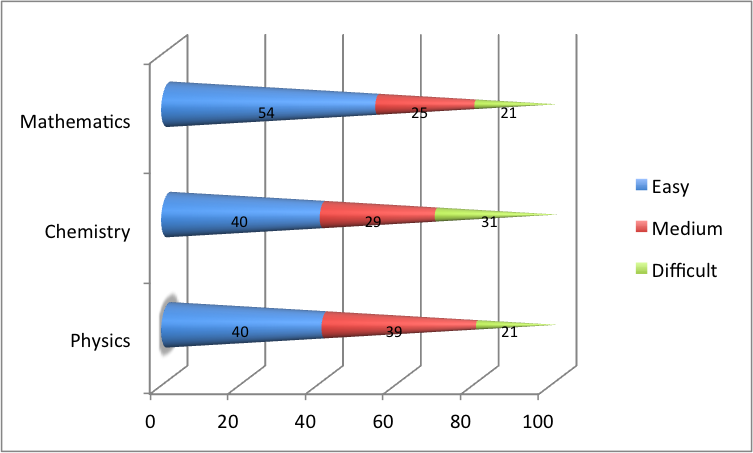
Fig. 1 : Level of Difficulty

Talking about the difficulty level, I personally found Mathematics easier than the other two. But based on the student and teacher feedback, the chart shows the level of difficulty of questions in each subject. So, among the individual subjects, Chemistry was supposedly easier whereas Physics was the most difficult (comparatively). The numbers also clearly indicate that attempting the right questions in the examination can easily let any aspirant through, since there are sufficient number of easy questions asked; you just need to find them in the paper.


The above figures give you the topic-wise break-up of each subject. In each subject, if you had concentrated on preparing the chapters I had asked you to, you must have scored well. As expected, Coordinate and Vectors/3-D formed 27% of the Mathematics portion and all these questions were pretty straight forward and hence less time-consuming. Algebra formed the major portion of Mathematics as is always the case.

In Physics, Heat, Electrostat, Current & Magnetism, Modern and Sound formed more than 50% of the Physics paper. In Physics, a couple of questions were tricky and one question from Modern Physics (the one on modulated frequency) was out of syllabus, which made the paper a little difficult.

In Chemistry, if you had control over Physical and Organic Chemistry, the paper must have been a cakewalk for you.

Coming to the most important part of this article – expected ranking of students who know their approximate scores and the expected cut-off for JEE Advanced 2013.

Since I believe in equal opportunity for all, I am only going to discuss the cut-offs for the General Category. According to my analysis, the topper is expected to get about 342 marks. I talked to the FIITJEE topper and he has scored 330. So, the topper is expected to be from some other Coaching Institute. The competition will become very tough in terms of marks as we go lower down the rankings. 

The cut-off for JEE Advanced for General Category according to me, should be around 129 marks (refer the given table; considering only 51% of 150,000 = 75000 approx. will qualify for JEE Advanced). 


Tabulated above is the aggregate score against one’s expected ranking according to my analysis.

The actual data will however be known only when the results are out on May 7, 2013 (on this date, only the scores will be released). Until then, we can only publish the ‘expected’ rankings and ‘expected’ cut-offs. The Class XII marks also need to be considered for the actual rankings. The way forward for students now is to focus on other major examination(s) – be it JEE Advanced and/or some regional engineering entrance examinations.


If you have any questions/comments, you can interact with me on www.facebook.com/abbyshekchandra

Wishing all the students “All the Best” for their results and their upcoming examinations. Hope the article helps!

Disclaimer : All the data in the article are solely based on the author’s individual analysis. The author does not guarantee the numbers to match the actual outcome.


Tuesday, April 10, 2012

IIT-JEE 2012 : Analysis, Expected Cut-offs and Rankings


On April 8, 2012, about 5 lakh students appeared for IIT-JEE across the country for admission into the prestigious IITs. Since the students were allowed to carry a carbon copy of the OMR (answer) sheet, they would have already calculated their scores by now. But what matters the most for qualifying is the relative score and hence cut-offs for which some amount of examination analysis is required.  

As usual, the IIT-JEE was conducted in two parts – Paper I and Paper II. Paper I was of 210 marks (70 marks each for Physics, Chemistry & Mathematics) while Paper II was of 198 marks (66 marks each for Physics, Chemistry & Mathematics) making the total marks for IIT-JEE 408 this year unlike previous year’s 480. The number of questions was also reduced this year to allow students to attempt all the questions. Quite a few questions were thought provoking.

The type of questions asked in Paper I were “Single Correct Answer Type”, “Multiple Correct Answers Type” and “Integer Type” while those asked in Paper II were “Single Correct Answer Type”, “Multiple Correct Answers Type” and “Comprehension Type”. What was surprising was that the “Matrix – Match Type” questions that used to be the most challenging ones (difficult and time-taking) had been done away with making both the papers simpler.  


Fig. 1 : Level of Difficulty

Students were excited after Paper I that was comparatively easier than Paper II.   Overall, among the individual subjects, Mathematics was the easiest; some students found Chemistry as the toughest while others found Physics to be the most difficult. I personally found Physics to be easier than Chemistry, Mathematics being the easiest. Based on the student and teacher feedback, the chart shows the level of difficulty of questions in each subject for both the papers combined. The numbers also clearly indicate that attempting the right questions in the examination can easily let any aspirant through, since there are sufficient number of easy questions asked; you just need to find them in the paper.


Fig. 2 : Physics topic-wise break-up


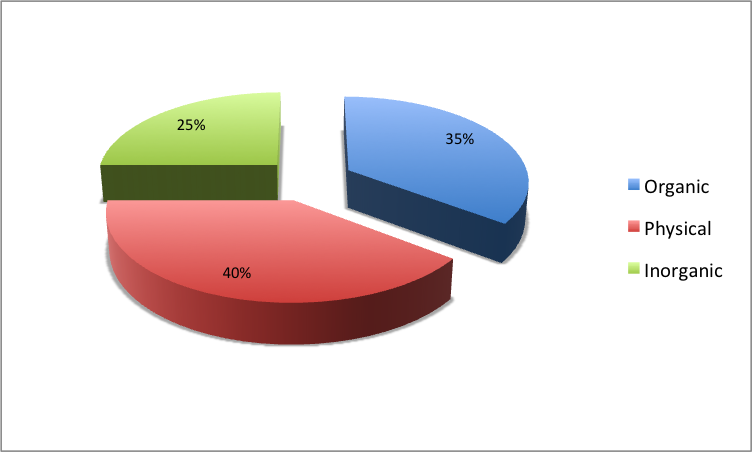
Fig. 3: Chemistry topic-wise break-up


Fig. 4 : Mathematics topic-wise break-up

Above are the topic-wise break-up of marks in Physics, Chemistry and Mathematics. Students who would have read and followed my previous article on “Last Week Preparation Guide for IIT-JEE 2012”
(http://www.gyancentral.com/articles/graduate/engineering/engineering-entrance-exams/the-last-week-preparation-guide-for-iitjee-2012) would have gained a lot because in the last week, they would have revised the relevant topics suggested.

In Physics, questions on Current Electricity & Magnetism, Electrostat, Heat, Modern and Sound formed a major percentage of total marks and could have been solved with ease. In Chemistry, though questions on Organic Chemistry and Inorganic Chemistry formed a decent percentage of the total questions asked, it was dominated by Physical Chemistry.  

Talking about Mathematics, a lot of questions were asked from Calculus and that made some part of the paper a little tricky though considerable portion was easy. Quite a few questions were directly from Eduwiser Publishing Group books (like the ones from Permutation & Combination, Vectors & 3-D Geometry, Limits, etc.) with very slight data change. Coordinate Geometry and Vectors & 3-D Geometry continued to be evergreen and highly rewarding but safe topics.

Coming to the most important part of this article – expected ranking of students who know their approximate scores and the expected cut-offs for the IIT-JEE 2012.


Since I believe in equal opportunity for all, I am only going to discuss the cut-offs for the General Category. According to my analysis, the students will need to score a minimum of 14, 14 and 20 marks in Chemistry, Physics and Mathematics to be considered for IIT-JEE rankings. These are called the MQMR – Minimum Qualifying Marks for Ranking and are different from the marks of the last ranked candidate (which the people wrongly refer to as individual subject cut-offs) in IIT-JEE. The aggregate cut-off this time is expected to touch 188 marks. So, the IITs will probably release rankings for students who score 188 marks and more (provided they have scored the MQMR for individual subjects). For students who get very low ranks (say 9000 and beyond), they must know that their admission into any of the IITs will depend on availability of seats. Merely receiving a rank from IITs does not guarantee admission into IITs.


Tabulated above is your aggregate score against your expected ranking according to my analysis. The last ranked candidate is expected to score an aggregate of 188 marks while the topper is expected to score an aggregate of 374 marks.

The actual data will however be known only when the results are out on May 18, 2012. Until then, we can only publish the ‘expected’ rankings and ‘expected’ cut-offs. The way forward for students now is to focus on their next major examination(s) – be it AIEEE and/or MHCET, etc. thinking that they are not going to get through IIT-JEE. This will probably help them perform better in the remaining examinations.

Wishing all the students “All the Best” for their IIT-JEE results and their upcoming examinations.

Disclaimer : All the data in the article are solely based on the author’s individual analysis. The author does not guarantee the numbers to match the actual outcome.

If you have any questions/comments, you can interact with me on www.facebook.com/abbyshekchandra